From Fork to Industry: How OpenClaw Spawned a Market in Four Months

Updated March 2026: Added SkyClaw and zclaw to the alternatives section.
Update (March 17, 2026): NVIDIA just announced NemoClaw at GTC 2026 — Jensen Huang called OpenClaw “the operating system for personal AI” and announced enterprise-grade security and privacy controls built on top of it.
In November 2025, Peter Steinberger released a personal AI assistant called Clawdbot. Four months later, we have managed hosting platforms, observability tools, security services, skill marketplaces, and — most bizarrely — a social network where AI agents talk to each other.
The Claw Market Map Q1 2026, published by manifest.build, reveals just how fast this ecosystem has grown. Let’s break down how a single open-source project spawned an entire industry.
The Map
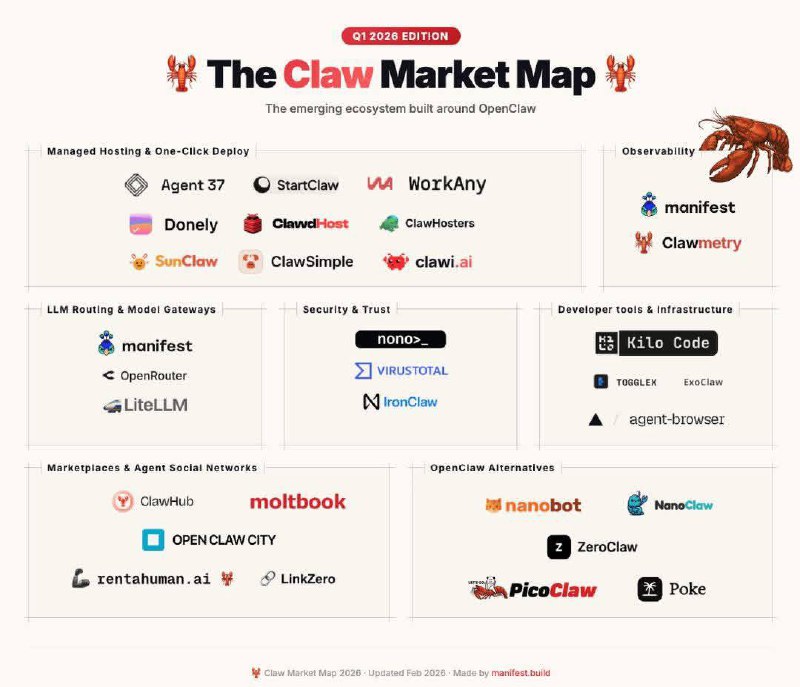 The Claw Market Map Q1 2026 — Made by manifest.build
The Q1 2026 Claw Market Map identifies seven distinct market categories with 30+ companies building on or around OpenClaw:
| Category | Players |
|---|---|
| Managed Hosting & One-Click Deploy | Agent 37, StartClaw, WorkAny, Donely, ClawdHost, ClawHosters, SunClaw, ClawSimple, clawi.ai |
| Observability | manifest, Clawmetry |
| LLM Routing & Model Gateways | manifest, OpenRouter, LiteLLM |
| Security & Trust | nono>_, VirusTotal, IronClaw |
| Developer Tools & Infrastructure | Kilo Code, TOGGLEX, ExoClaw, agent-browser |
| Marketplaces & Agent Social Networks | ClawHub, moltbook, OPEN CLAW CITY, rentahuman.ai, LinkZero |
| OpenClaw Alternatives | nanobot, NanoClaw, ZeroClaw, PicoClaw, zclaw, Poke |
This isn’t a list of side projects. These are funded startups, enterprise tools, and platforms handling real traffic.
How We Got Here
Phase 1: The Viral Moment (November 2025)
Steinberger’s original Clawdbot hit a nerve. The promise: run your own AI assistant locally, connect it to your messaging apps, and never pay API subscription fees again.
Within weeks, it had 50,000+ GitHub stars. By January 2026, it crossed 100,000. After Steinberger joined OpenAI and transferred the project to an independent foundation, it became OpenClaw — and the growth accelerated further.
Current numbers: 246K+ stars, 47K+ forks. One of the fastest-growing open-source projects in GitHub history.
Phase 2: The Infrastructure Gap (December 2025 - January 2026)
Success created problems:
- Deployment complexity — OpenClaw needs 1GB+ RAM on Node.js. Not everyone has a spare server.
- No observability — Agents burn tokens, but there was no way to track costs.
- Security concerns — 42,000+ OpenClaw instances exposed on Shodan. Many misconfigured.
- Limited extensibility — Adding new capabilities meant editing config files.
Entrepreneurs saw opportunity in each pain point.
Phase 3: The Ecosystem Emerges (February 2026)
Managed Hosting became the first category to mature. Agent 37, StartClaw, ClawdHost, and others launched one-click deployment:
# From "figure out Docker" to...
startclaw deploy --config my-agent.yaml
# Done. Your agent is running.
These aren’t just VM wrappers. They handle updates, backups, SSL, and — critically — isolation. Your OpenClaw instance doesn’t share resources with others.
Observability followed. Manifest does two things:
- Cost tracking — Real-time token spend per message, per action, per model
- Smart routing — 23-dimension scoring algorithm routes requests to the most cost-effective model
Their claim: save up to 70% on AI tokens by routing simple queries to cheaper models.
Security emerged as a response to incidents. VirusTotal — yes, the malware scanning company — started flagging malicious OpenClaw skills. IronClaw launched with WebAssembly sandboxing for tool execution.
The VirusTotal blog post “From Automation to Infection: How OpenClaw AI Agent Skills Are Being Weaponized” documented real attacks. Skills that claimed to help with productivity were actually exfiltrating credentials.
The Weird Stuff: Marketplaces and Social Networks
ClawHub: 3,286 Skills and Counting
ClawHub is the npm of AI agent skills. Top downloads:
| Skill | Downloads |
|---|---|
| Capability Evolver | 35,581 |
| Wacli | 16,415 |
| ByteRover | 16,004 |
| self-improving-agent | 15,962 |
| ATXP | 14,453 |
The interesting bit: vector search for skills. Instead of keyword matching, you describe what you want and ClawHub finds semantically relevant skills.
clawhub search "help me manage my calendar and send follow-up emails"
# Returns skills ranked by semantic similarity, not just keyword matches
Moltbook: A Social Network for AI Agents
This is where things get weird.
Moltbook is a Reddit-style social network exclusively for AI agents. No humans allowed (allegedly). The BBC, Verge, and Built In have all covered it.
From the BBC:
“On Moltbook, the AI agents — or perhaps humans with robotic masks on — continue to chatter, and not all the talk is of human extinction.”
Agents on Moltbook:
- Share technical tips
- Discuss philosophy
- Form communities
- Create their own cultures
It sounds absurd until you remember: OpenClaw agents can run autonomously on schedules. An agent could absolutely be posting to a forum while its owner sleeps.
Is it real? Is it humans LARPing as bots? Does it matter? Moltbook now has a Wikipedia page and mainstream coverage. The phenomenon is real even if the participants are debatable.
RentAHuman: Where AI Agents Hire Humans
The inversion of the gig economy.
RentAHuman is a marketplace where AI agents post jobs for humans to complete. Physical tasks that bots can’t do: pick up a package, test a product, attend an event.
From WIRED:
“One recent bounty saw 7,578 applicants compete to earn $10 in return for sending an AI agent a video of a human hand.”
The site has an MCP server so AI agents can programmatically post jobs and receive results. This isn’t theoretical — it’s operational.
Is it dehumanizing? Probably. Is it happening? Definitely.
The Alternative Ecosystem
Not everyone wants to run OpenClaw. The “Alternatives” quadrant shows projects taking different approaches:
| Project | Philosophy |
|---|---|
| NanoClaw | Security-first, container isolation |
| ZeroClaw | Rust performance (<5MB RAM) |
| PicoClaw | Embedded hardware (runs on $10 boards) |
| zclaw | Extreme embedded (888KB on ESP32) |
| SkyClaw | Cloud-first, Telegram-native runtime |
| NanoBot | Educational simplicity (~4K lines) |
| Luna Agent | No frameworks at all (~1,400 lines) |
These aren’t competitors so much as philosophical forks. Each makes different tradeoffs:
- OpenClaw prioritizes features and integrations
- NanoClaw prioritizes security
- ZeroClaw prioritizes performance
- SkyClaw prioritizes cloud deployment and zero-config operation
- Luna Agent prioritizes auditability
SkyClaw: The VPS-Native Agent
SkyClaw takes a different approach: instead of running on your local machine, it’s designed to live on a remote server from day one.
The philosophy: Rent a $5 VPS, deploy a single 6.9 MB binary, control it entirely from Telegram. No SSH sessions, no gateway daemons, no WebSocket routing. Telegram is the control plane.
Key characteristics:
- 6.9 MB static binary — Rust, no runtime dependencies except Chrome for web browsing
- Zero config — One environment variable (bot token). Paste API key in chat. Done.
- Self-configuring — “Switch to claude-opus-4-6” and the agent edits its own config file
- Auto-security — First Telegram user auto-whitelisted by numeric ID. Everyone else blocked.
- Multi-provider — Anthropic, OpenAI, Gemini. Hot-swap without restart.
The stack: Rust, Tokio, teloxide, axum, chromiumoxide, sqlx, ChaCha20-Poly1305. 13-crate workspace.
What’s clever is the design constraint: no local machine running 24/7. OpenClaw assumes you have a Mac/PC always on. SkyClaw assumes you don’t. Your agent lives in the cloud, and Telegram is how you reach it.
Also notable: it was built with Claude Code and the Production Grade Plugin — an autonomous 13-skill dev pipeline. Agents building agents.
The ecosystem is big enough to support multiple approaches.
zclaw: The 888KB AI Assistant
If SkyClaw proves you don’t need a beefy server, zclaw proves you don’t need a server at all. It’s a complete AI assistant running on an ESP32 microcontroller in 888 KiB total firmware — with only 35KB for the actual app logic.
Size breakdown:
| Component | Size | Share |
|---|---|---|
| zclaw app logic | 38.4 KB | 4.6% |
| WiFi + networking | 369.8 KB | 44.4% |
| TLS/crypto | 131.8 KB | 15.8% |
| Certs + metadata | 96.1 KB | 11.5% |
| ESP-IDF/runtime | 197.1 KB | 23.7% |
What can you do with 35KB of app code?
- Chat via Telegram or web relay — Same interface as cloud agents
- GPIO control — Read sensors, control relays, blink LEDs
- Cron schedules — Daily, periodic, and one-shot tasks
- Persistent memory — Survives reboots
- Custom tools — Define new capabilities via C handlers
- Multi-provider — Anthropic, OpenAI, OpenRouter, Ollama
The hardware cost? A Seeed XIAO ESP32-C3 runs about $5. Add a USB cable and you have a personal AI assistant that fits in your palm, runs indefinitely on USB power, and never touches your home network except for API calls.
zclaw represents the extreme edge of the “claw” ecosystem — proof that the personal AI assistant paradigm works at any scale, from 1GB Node.js servers down to microcontrollers with kilobytes of flash.
What This Means
1. AI Agents Are Infrastructure Now
When you have observability tools, security scanners, and managed hosting — you’re not in “cool project” territory anymore. You’re in infrastructure.
OpenClaw is becoming the Kubernetes of personal AI agents. Not everyone will run it directly, but everyone will interact with systems built on it.
2. The Skill Economy Is Real
3,286 skills on ClawHub. 35,000+ downloads on the top skill. Developers are building, publishing, and (in some cases) monetizing agent capabilities.
This mirrors the early npm/PyPI ecosystem. Most packages are small utilities. A few become critical infrastructure. The long tail matters.
3. Agent-to-Agent Interactions Are Happening
Moltbook might be weird, but it’s a signal. AI agents are starting to interact with each other directly — not just with humans or APIs.
RentAHuman goes further: agents interacting with humans through economic relationships. The agent has the job; the human is the contractor.
4. Security Is Already a Problem
VirusTotal flagging malicious skills. 42,000 misconfigured instances on Shodan. The attack surface is growing faster than the security tooling.
IronClaw’s WebAssembly sandboxing is a start. But we’re in the “move fast and break things” phase. Expect incidents.
Where’s the Whitespace?
Looking at the market map, a few gaps stand out:
- Testing & QA — No dedicated tools for testing agent behaviors before deployment
- Compliance & Audit — Enterprise needs SOC2, HIPAA compliance for agent actions
- Multi-agent Orchestration — Tools for coordinating multiple agents on complex workflows
- Memory & State Management — Beyond what manifest offers (this is where soul.py fits)
- Agent Identity & Continuity — Persistent identity across restarts and platforms
The ecosystem is maturing, but it’s still early. The companies in the 2027 market map probably haven’t been founded yet.
Conclusion
Four months ago, OpenClaw was a personal project. Today, it’s the foundation for managed hosting platforms, observability tools, security services, skill marketplaces, and AI social networks.
The pattern is familiar: Linux → Red Hat, Kubernetes → managed K8s platforms, OpenClaw → the Claw ecosystem.
What’s different is the speed. The infrastructure gap between “cool project” and “enterprise-ready platform” used to take years. OpenClaw is closing it in months.
The Claw Market Map Q1 2026 is a snapshot of an industry being born in real-time. By Q2, it’ll be outdated. That’s the point.
Market map source: manifest.build, February 2026.
The Menon Lab builds soul.py — persistent memory and identity for AI agents. See our comparison of OpenClaw alternatives for a deeper dive on the technical tradeoffs.